
Districts and surroundings · local market
Real estate in the Śródmieście district: local market and transaction services
Properties in the district Śródmieście: a local guide to prices, demand, sales, purchases, rentals and valuations, taking into account the specifics of the district.
District overview
Śródmieście is the center of Warsaw in the geographical, administrative and symbolic sense. This is where the main axes of the city intersect: administration, culture, offices, transport, history and the most limited supply of central addresses.
The district covers very different areas: Powiśle and Solec on the Vistula River, Muranów in the north, the vicinity of the Royal Route, the office center and more residential parts. Each of them has a different price, rental and demand logic.
Geographically, Śródmieście touches Wola, Żoliborz, Mokotów, Ochota and Prague on the other side of the Vistula. Metro, trams, railway, bridges, Marszałkowska, Aleje Jerozolimskie and Wisłostrada constitute the most complex transport system in the city.
The interesting thing about the Śródmieście district is that its prestige does not always mean peace. Some addresses are great for premium rentals or for people who value a quick commute to work, others offer greenery and silence, and still others require caution due to noise or the condition of the building.
For buyers, Śródmieście is chosen for its central location and market liquidity. For sellers, a strong address can help, but the best result depends on showing a specific advantage: view, layout, building history, quietness, transportation or rental potential.
History of the district
From the medieval city and the royal axes to the rebuilt capital
"Śródmieście" is a functional term for the central part of Warsaw, not the name of one former settlement. It covers many historical Warsaws at once: the medieval Old Town, the later New Town, jurydyki, the royal route to Ujazdów and Wilanów, and the Saska and Stanisławowska axes. They were shaped by Masovian princes, kings, magnates, orders, townspeople, architects and engineers. Under Stanisław August, Łazienki and the representative layouts of the southern part of the city were developed.
The 19th century brought tenement houses, railways, waterworks, financial institutions and a multicultural metropolis. The extermination of Warsaw's Jews, the Warsaw Uprising and the German destruction of the city in 1944 interrupted this continuity. Post-war reconstruction under the direction of the Capital Reconstruction Office recreated the Old Town, but at the same time introduced new axes, the socialist realist MDM and the Palace of Culture and Science.
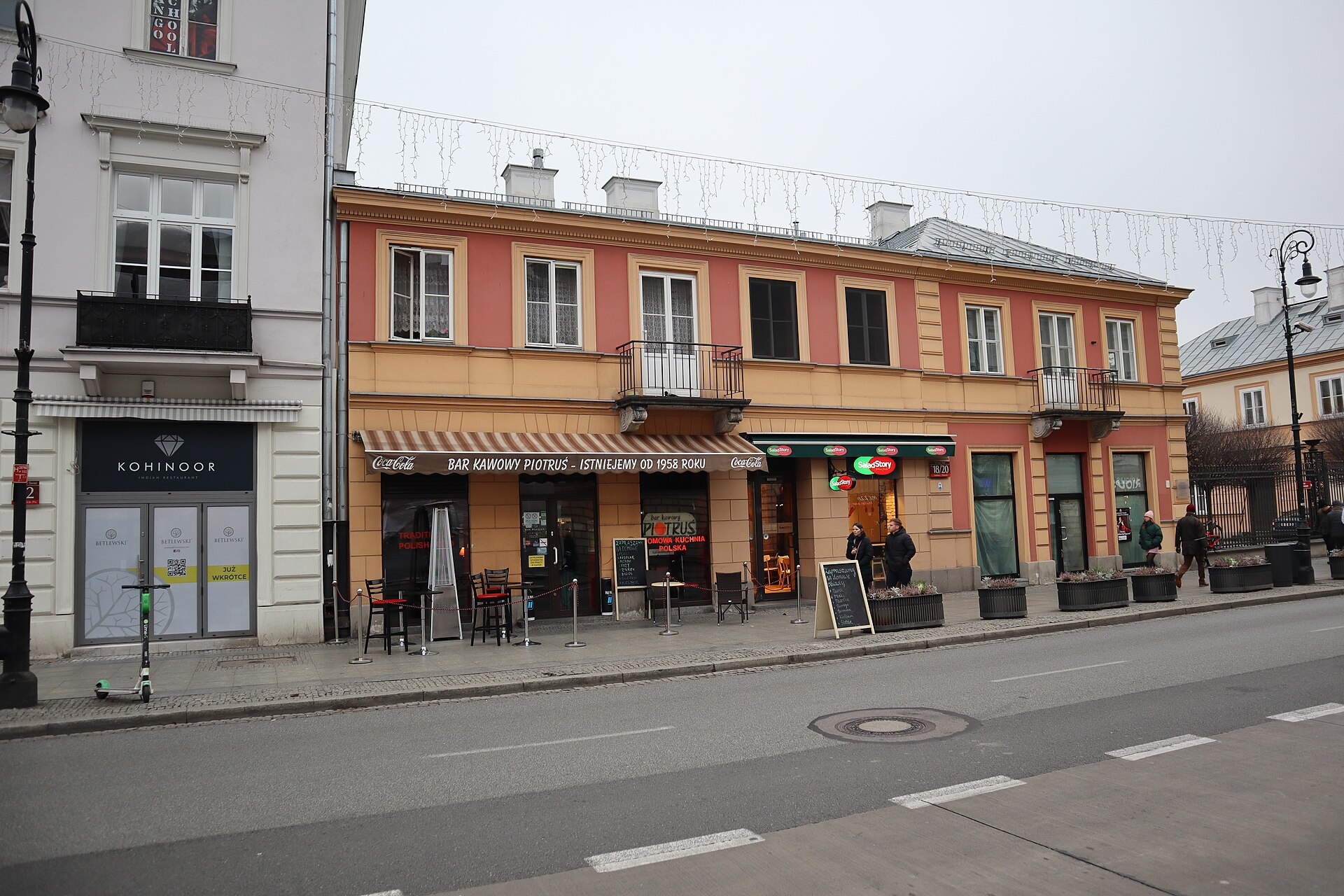
What can still be seen: layers from the Gothic street layout, through Baroque palaces and 19th-century tenement houses, to post-war reconstructions, modernism and contemporary high-rise buildings.
For new residents
Śródmieście after the move: the largest selection of culture and gastronomy in the city
Restaurants, cafes, bars and clubs are concentrated in several places: on the Royal Route, in the Powiśle district, around Plac Zbawiciela, at Poznańska Street, in Koszyki, in Nowy Świat and in the Old Town. Each of them has a different rhythm, noise level and price profile.
Culture within walking distance
- National Museum and Zachęta: large art collections and temporary exhibitions.
- Teatr Wielki, National Theater and TR Warszawa: opera, drama and contemporary theater in several parts of the center.
- Cinematheque and arthouse cinemas: cinema in the Palace of Culture and smaller arthouse cinemas in the center.
Food, clubs and greenery
- Hala Koszyki, Powiśle and the area around Plac Zbawiciela: various concentrations of gastronomy, from food halls to small street establishments.
- Nowy Świat and Pavilions: intense evening life; living in the immediate vicinity means noise.
- Łazienki Królewskie, Saski Garden and boulevards: the most important walking and recreational areas of the center.
Schools and education
- Public primary school and district: a child living in the district is entitled to a place in the assigned school after submitting an application. Choosing a school outside the district means recruiting for vacant places. Before signing the contract, check the perimeter of the exact address and the safe walking route; do not base your decision solely on the description of the real estate offer.
- Recruitment for kindergartens, secondary schools and private schools is carried out according to separate rules and deadlines. Compare the current offer in the city's school database, transport, community center, additional classes and admission procedure for a given year.
Grocery shopping
- Hale Mirowskie and Mirowski Square: hall, shops, bakeries and stands with vegetables, fruit and other everyday products.
- Złote Tarasy and Plac Unii: two central complexes with food offerings; Plac Unii is located on the downtown side of the border with Mokotów.
Practically: Visit the address on Friday or Saturday after 10 p.m. In the Śródmieście district, the difference of one street can mean completely different levels of nighttime noise, tourist traffic and parking availability.
Properties in the district Śródmieście
At Jagiełło and Partners, we compare properties in the Śródmieście district with similar premises, houses or commercial spaces, instead of basing the decision on the overall average for the city.
- Real estate in Warsaw
- real estate market in Warsaw
- apartment valuation in Warsaw
- local consultation
Local market
In this district, central apartments, premium rentals and addresses with limited supply are particularly important. Offer prices must be compared with the prices of similar premises, and not with the price level in the entire city.
This is especially important when selling, because the proper justification of the price depends on the building, street, standard and actual group of buyers.
- building type
- standard
- exposure time
- demand for real estate on a specific street
Information for buyers
The buyer should check whether the property fits into the daily rhythm of life: access, services, greenery, family plans or intended for rent. The main connections are metro, trams, railways and the possibility of getting around the center on foot.
The best property is not always the most attractive offer. It's the one that fits the customer's budget, usage and long-term plan.
Information for sellers
The seller should know which features of the property in the Śródmieście district are the strongest argument and which may reduce interest. This affects the price, description, photos and negotiations.
We focus on clearly demonstrating the strongest local arguments and sorting out risks before they undermine sales.
Schools, transportation and amenities
Transport: metro, trams, railways and the possibility of getting around the center on foot. Amenities: parks, culture, restaurants, offices and historic streets. When choosing a property, it is worth checking the daily route, noise, parking and nearest services.
Schools and family infrastructure are important to many buyers, but in Warsaw it is best to evaluate them together with access, the quality of the housing estate and the real rhythm of the area.
Local market context
We evaluate the local market by property type, building condition, floor, exposure, demand, price context and buyer or seller goal.
If you are selling, the best first step is usually a valuation. If you are buying, start by narrowing down the area and price range before filling your calendar with viewings.
- two- or three-room apartment
- premium premises
- investment property
- house or section
Official transaction data
Transaction prices of apartments in the Śródmieście district, RCIWN documents from 2025
The aggregate includes residential premises sold on the free secondary market and registered in the Register of Real Estate Prices and Values of the Capital City of Warsaw. Warsaw based on documents from 2025.
How to read this data
This is a market description, not an automatic valuation of a specific apartment. The given year is the year of preparation of the document registered in the RCIWN. The list removes repetitions regarding premises and transactions, uses the gross price of the premises and usable area, and rejects observations outside the range of PLN 3,000-80,000/m² and 10-400 m² as requiring separate verification.
The price of a specific premises is influenced by, among others: street, building, floor, condition, exposure, layout, title to the property and current competition. Source: RCIWN m.st. Warsaw; REST service documentation. Data downloaded on July 10, 2026.
FAQ
Frequently asked questions
Is Śródmieście a good neighborhood to buy?
It depends on the goal. Śródmieście may be a good choice if the property fits your budget, access and use plan.
How to price an apartment in the Śródmieście district?
It is best to compare similar premises in the same part of the district, rather than the average for the entire Warsaw.
Do you help sellers and buyers in this district?
Yes. We help with valuation, analysis of offers, negotiations and understanding the provisions of the contract.
Related topics
Related pages and services
Apartments in the district Powiśle
Apartments in the district Muranów
Apartments in the district Solec
Properties in the district Żoliborz
Properties in the district Wola
Properties in the district Ochota
Properties in the district Mokotów
Properties in the district Praga-Północ
Properties in the district Praga-Południe
Sale of apartments in Warsaw
Buying an apartment in Warsaw
Appraisal of an apartment in Warsaw
Next step
Ask about real estate in the Śródmieście district
Briefly describe the property, neighborhood or purpose. We will answer specifically and indicate the next step.
Ask about real estate in the Śródmieście district